




Quick Answer
Keeping marble and granite looking new in the UAE comes down to four habits: dust and sweep regularly to remove abrasive sand, clean only with a pH-neutral stone cleaner (never vinegar, lemon or bleach), wipe spills immediately, and reseal periodically, marble roughly every 6-12 months and granite every 1-2 years.
Heat, humidity and fine sand are the main local challenges, and correct sealing combined with gentle cleaning handles all three.
Natural stone is built to last, but the UAE puts it to the test, relentless sun, seasonal humidity, hard water and ever-present fine sand. The good news is that caring for marble and granite is straightforward once you know the rules.
Follow the guidance below on cleaning, sealing and stain removal, and your floors and surfaces will stay beautiful for decades with very little effort.
Key Takeaways
- Sand is the enemy of shine, sweep often to stop fine grit scratching the surface.
- Go pH-neutral, acidic and harsh cleaners etch and dull natural stone.
- Sealing is your shield, it is the single most important step for stain resistance.
- Act fast on spills, prompt clean-up prevents most permanent staining.
How does the UAE climate affect natural stone?
Three local factors matter most. Fine, wind-blown sand acts like a mild abrasive underfoot and can scratch polished surfaces if it is not removed regularly. Seasonal humidity can encourage moisture-related staining on unsealed stone. And hard water can leave mineral deposits on surfaces around sinks and bathrooms.
None of these is a problem for well-maintained, properly sealed stone, but each is a reason to stay on top of a simple care routine rather than leaving it to chance.
How should you clean marble and granite day to day?
Daily care is simple and quick:
- Dust-mop or sweep floors regularly to lift abrasive sand and grit.
- Wipe surfaces with a soft cloth and warm water, or a pH-neutral stone cleaner.
- Dry surfaces around sinks to prevent hard-water marks.
- Blot spills immediately rather than wiping, which can spread them.
What should you never use on natural stone?
Some common household products do real damage. Use the column on the left and avoid the one on the right:
| Do use | Don’t use |
|---|---|
| pH-neutral stone cleaner | Vinegar, lemon or citrus cleaners |
| Warm water and a soft cloth | Bleach or ammonia |
| Microfibre or soft mop | Abrasive scouring pads |
| Stone-safe sealer | Generic all-purpose sprays |
Acidic products are especially harmful to marble, which is calcium-carbonate based and etches on contact with acids.
How often should you seal marble and granite?
Sealing fills the stone’s microscopic pores so liquids cannot soak in. As a general guide, reseal marble every 6-12 months and granite every 1-2 years, adjusting for how heavily the surface is used.
The easiest test is the water-drop test: place a few drops of water on the surface; if they bead up, the seal is fine; if they soak in and darken the stone, it is time to reseal. Sealing is quick and dramatically improves stain resistance, which is why we recommend it for every floor and worktop.
How do you deal with stains and etch marks?
- Organic stains (coffee, tea, wine): clean with a pH-neutral cleaner; stubborn marks may need a stone-safe poultice.
- Oil-based stains (grease, cosmetics): blot, then use a poultice designed to draw out oil.
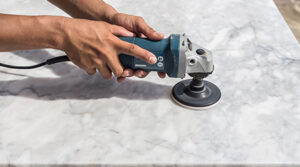
- Etch marks on marble (dull spots from acids): these are surface damage, not stains, and usually need professional polishing to restore.
- Hard-water marks: a stone-safe cleaner and regular drying around taps keep them at bay.
For badly worn or etched floors, professional restoration can bring stone back to life. Correct installation also reduces long-term problems, see our installation guide.
Do marble and granite need different care?
The principles are the same, but the emphasis differs. Marble is softer and more reactive to acids, so it needs more frequent sealing and stricter avoidance of acidic cleaners. Granite is harder and less porous, so it is more forgiving day to day, though it still benefits from periodic sealing.
Understanding these differences is easier with our marble vs granite comparison and our granite countertops guide.
Why choose Marmara Marble & Granite for stone care advice in the UAE?
Because we supply, fabricate and install the stone, Marmara Marble & Granite can advise on exactly how to care for it. From recommending the right sealer to guiding cleaning routines and arranging professional restoration, our team supports clients long after installation.
If you are unsure how to maintain a specific stone or finish, we are happy to help. Get in touch via the products page or learn more about Marmara.
About the Author
Tejesh Chinthagumpala, Managing Director, Marmara Marble & Granite LLC
Tejesh Chinthagumpala is the Managing Director of Marmara Marble & Granite LLC, a UAE-based natural stone supplier and installer. A civil engineer and PMP-certified project manager trained at NICMAR Hyderabad, he previously delivered large-scale projects with Desert Group in Dubai. Since acquiring Marmara in 2022, he has grown the company from seven to 150+ specialists and expanded its operations across the UAE, Oman and Saudi Arabia.
Frequently Asked Questions
How do I clean marble floors in Dubai?
Sweep regularly to remove sand, then clean with warm water or a pH-neutral stone cleaner and a soft mop. Avoid vinegar, lemon and other acidic products, which etch and dull marble.
How often should I seal my stone in the UAE?
As a guide, reseal marble every 6-12 months and granite every 1-2 years. Use the water-drop test, if water soaks in rather than beading, it is time to reseal.
Can I use vinegar to clean marble or granite?
No. Vinegar and other acidic cleaners damage natural stone, especially marble, by etching the surface. Always use a pH-neutral, stone-safe cleaner instead.
How do I remove a stain from marble?
For organic or oil-based stains, a stone-safe poultice can draw out the discolouration. Dull etch marks from acids are surface damage and usually require professional polishing to repair.
Does the UAE’s sand really damage stone floors?
Fine sand acts as a mild abrasive and can scratch polished surfaces over time if left underfoot. Regular sweeping and entrance mats are the simplest, most effective protection.
Is granite easier to maintain than marble?
Generally, yes. Granite is harder and less porous, so it is more forgiving day to day. Both stones benefit from pH-neutral cleaning and periodic sealing, but marble needs more frequent attention.